One platform for the full emergency lifecycle
Command Bridge gives emergency managers, EOCs, and public safety agencies a single system to manage incidents, coordinate teams, track resources, and communicate with the public — from initial activation through FEMA reimbursement.
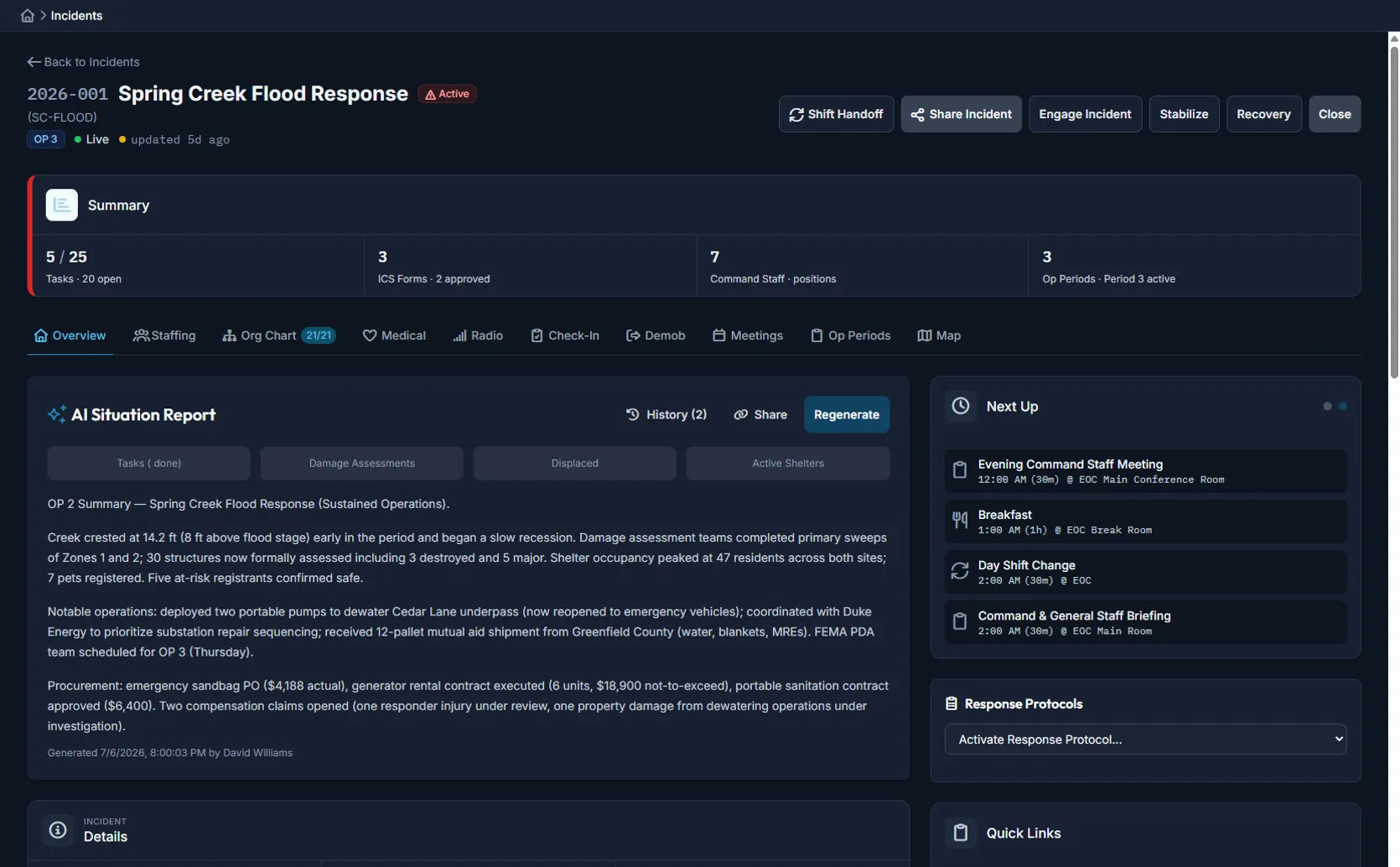
The coordination problem
Disconnected tools create confusion when every second counts
Most emergency operations rely on a patchwork of systems that don't talk to each other. When conditions escalate, fragmentation becomes a direct threat to response effectiveness.
Situational awareness breaks down
Mapping in one tool. Notifications in another. ICS forms on paper. Personnel tracking on a whiteboard. When the situation changes fast, your team is switching tabs instead of making decisions.
Field teams lose connectivity
Most platforms fail when cell towers go down. Your field teams lose access to damage forms, shelter check-ins, and supply requests exactly when they need them most.
FEMA documentation starts from scratch
When response data doesn't flow into recovery workflows, your finance team spends weeks rebuilding cost documentation from memory and scattered spreadsheets.
Built for the worst day
When the disaster is real, the tools have to be too.
Floods, wildfires, hurricanes, and everything in between — Command Bridge was built by emergency managers who have sat in the EOC chair during real activations, not adapted from generic project management software.
How Command Bridge solves it
Every capability emergency managers need. One platform.
65 integrated features across incident command, field operations, communication, mapping, recovery, and more — designed for how emergency management actually works.
Unified Operational Map
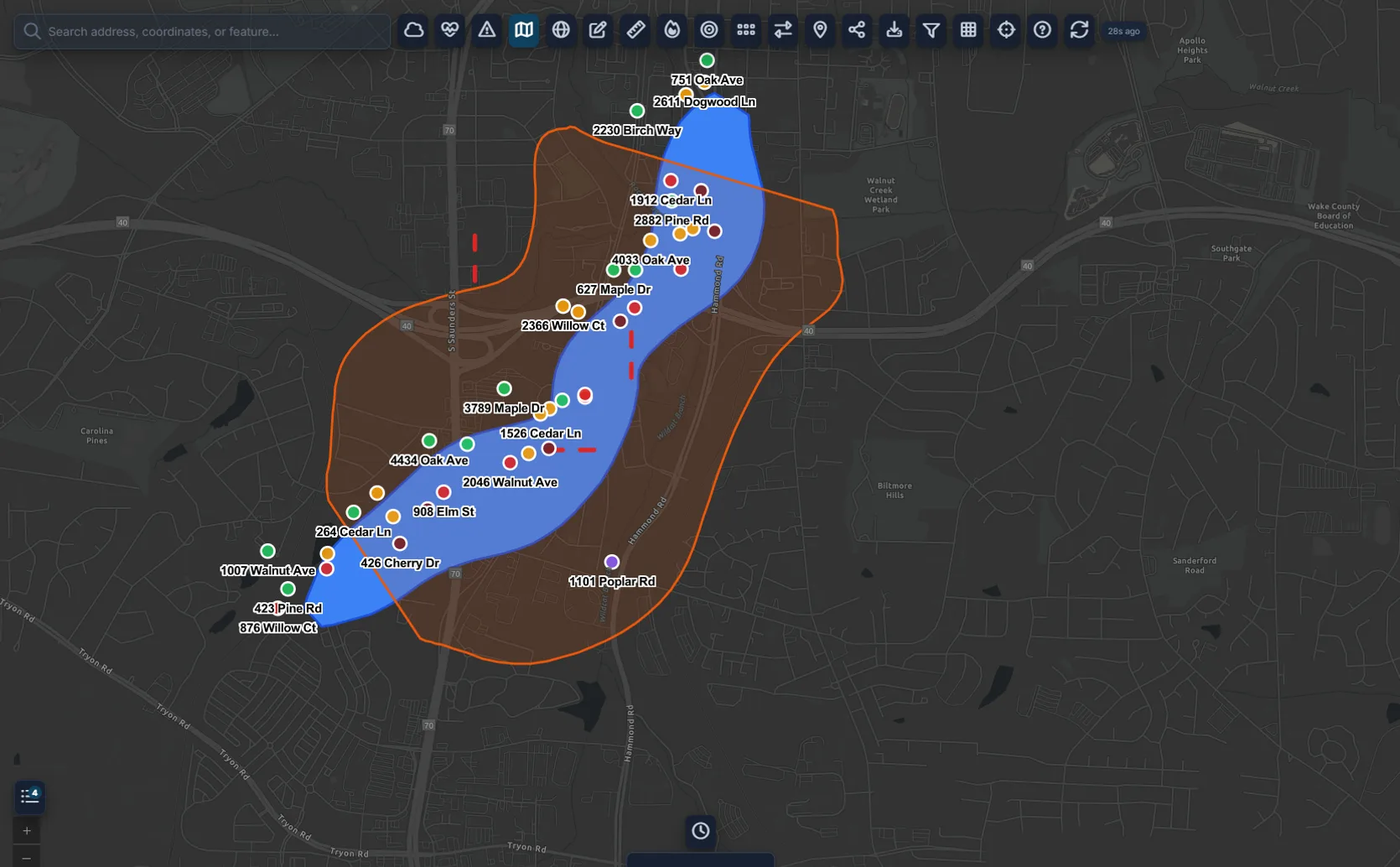
Every data point — damage reports, road closures, personnel positions, weather, evacuation zones — on one map that updates in real time.
See everything happening in your area of operations without switching between tools.
Multi-Channel Mass Notifications
One compose screen. Five channels — SMS, email, voice call, push notification, and webhook. Delivery tracking and acknowledgement per recipient.
Reach everyone who needs to know and confirm they received it.
Interagency Coordination
Share incident data with partner agencies through a controlled workflow. They view it in their own system. Revoke access any time.
Coordinate across agencies without losing control of your data.
Faster Incident Response
AI-generated briefings, auto-populated ICS forms, one-click SOP execution, and pre-built notification templates eliminate manual steps.
Less time compiling information. More time commanding the response.
Real-Time Situational Awareness
Live GPS tracking, weather from 15+ sources, automated threshold alerts, and shared map views with live cursors across your entire team.
Know what is happening across your area of operations at every moment.
Operational Readiness
COOP plans, credentialing, qualification tracking, workflow automation, and after-action reviews with corrective action tracking.
Be ready before the next event. Close gaps identified in prior incidents.
Why agencies switch to Command Bridge
Not another tool to manage. A fundamentally different architecture.
Most emergency management software covers one piece of the problem. Command Bridge replaces the entire patchwork.
End-to-end incident lifecycle
From activation to FEMA reimbursement in one system. A field damage assessment becomes a project worksheet line item — no re-entry, no rebuilding documentation after the fact.
17 modules work without cell service
When cell towers go down, your field teams keep working. Damage assessments, shelter check-ins, supply requests, and GPS tracking all save to the device and sync when signal returns.
Built-in community portal
Give your community one place for official information during an emergency. Shelters, road closures, and updates on your branded portal. Citizen damage reports flow straight into your assessment queue.
Complete command visibility
One shared operational map. Real-time updates from every team. When something changes in the field, command sees it immediately — no radio relay, no waiting for the next briefing.
Common operating picture
Everyone sees the same picture. In real time.
One ArcGIS-powered operational map with every data layer your team needs — personnel locations, weather conditions, damage reports, road closures, shelter status, evacuation zones, and resource deployments. When something changes in the field, everyone sees it.
- Real-time GPS tracking for every field team member
- 15+ weather data sources integrated directly on the map
- Shared map views with live cursors for coordinated briefings
- Geofencing with automatic boundary alerts
- Drawing, annotation, and measurement tools
- Fire behavior modeling and smoke tracking
Field-ready
Works where your teams work. Even without connectivity.
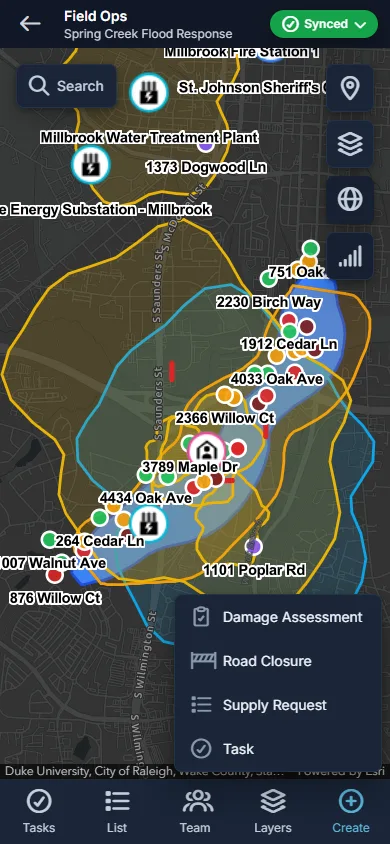
Purpose-built mobile interface for disaster conditions — not a desktop app crammed onto a phone. Large touch targets, simplified navigation, and full offline capability across 17 modules.
- 17 modules work without cell service
- Damage assessments with geotagged photos — online or offline
- Shelter check-in with health screening from a tablet
- Supply requests from the field through approval to fulfillment
- SOS panic button alerts command staff instantly
- Everything syncs automatically when connectivity returns
Built for the mission
Engineered for emergency operations — not adapted from generic software
Every feature in Command Bridge was built specifically for emergency management workflows, ICS structures, and FEMA compliance requirements.
ICS / NIMS Standards
Full ICS command structure, operational periods, and 7 auto-populated ICS forms — built on the frameworks your agency already uses.
FEMA-Ready from Day One
PA categories A-G, project worksheets, force account documentation, Community Lifelines dashboard, and ERG integration for HAZMAT.
Database-Level Security
Row-Level Security on every table. 247+ auditable resource types. 50+ permission controls. Tamper-proof audit trail.
Built for Disaster Conditions
17 modules work offline. Native mobile app. GPS tracking. SOS alerts. 65 integrated capabilities purpose-built for the field.
Pricing
No feature gating. No surprises. Just one price.
Pricing scales with your jurisdiction's population. Every team gets every capability from day one. Drone and AI modules available as add-ons.
How it works
- 1Full platform — no feature gating, ever
- 2Unlimited user accounts at every tier
- 3Transparent per-capita pricing based on population
- 4Specialized add-ons priced as a percentage of base
- 5Text, email, and voice alerts included — no per-message fees
- 6Interactive calculator — see your cost instantly
Frequently asked questions
Common questions from emergency managers evaluating Command Bridge.
Command Bridge is an all-in-one emergency operations platform that replaces the collection of disconnected tools most agencies use today. It covers the complete incident lifecycle — from initial activation through field operations, public communication, damage assessment, FEMA reimbursement, and after-action review — in a single integrated system.
Command Bridge is built for emergency management agencies at the county, city, and state level. It serves the full ICS structure: incident commanders, operations and planning sections, logistics and finance, public information officers, shelter coordinators, drone program managers, and agency administrators. It is designed for emergency operations centers, municipalities, state agencies, and any organization that coordinates incident response.
Seventeen modules work without any internet connection. When field teams lose cell service, they continue creating damage assessments, checking in shelter residents, submitting supply requests, and logging activities. Everything saves to the device and syncs automatically when connectivity returns — including photos and GPS positions.
Response costs are tracked by FEMA Public Assistance category (A through G) as they happen during operations. Force account labor hours, equipment usage, supply costs, and contract expenses are documented in real time. Project worksheets are maintained with federal, state, and local cost share calculations, and reports can be exported in FEMA-ready format.
Yes. Command Bridge supports multi-agency incident sharing through a controlled request-and-accept workflow. You can share incident data with partner agencies while maintaining full control — sharing is revocable at any time, and receiving agencies see shared data within their own secure environment.
Your agency's data is completely walled off from every other agency at the database level using Row-Level Security. Every action is logged in a permanent audit trail covering 247+ resource types. Access is controlled by 50+ permission settings with custom roles. Additional protections include session timeouts, failed login lockouts, IP restrictions, and API key management with scoped access.
Yes. Command Bridge includes digital ICS forms — 205, 206, 209, 211, 214, 221, and 230CG — that auto-populate from incident data. Your team can edit forms simultaneously with field-level locking, add digital signatures, and export to PDF. No more retyping the same information into every form.
By putting every team on one platform with one operational map, one notification system, and one set of forms that share data automatically. When a field team submits a damage assessment, command sees it on the map immediately. When the IC updates objectives, every ICS form reflects the change. There is one source of truth — not ten different spreadsheets and three different radio channels.
Modernize your emergency coordination
See how Command Bridge gives your agency one system for the entire incident lifecycle — from activation through FEMA reimbursement. No more switching between disconnected tools.